Beyond Prediction: Why Your Next Downtime Event Will Be Stopped by a Digital Twin, Not an Algorithm
By UpFix
Predictive maintenance alone cannot model cascading failures. Learn how digital twins combine real-time data and physics-based simulation to improve reliability.
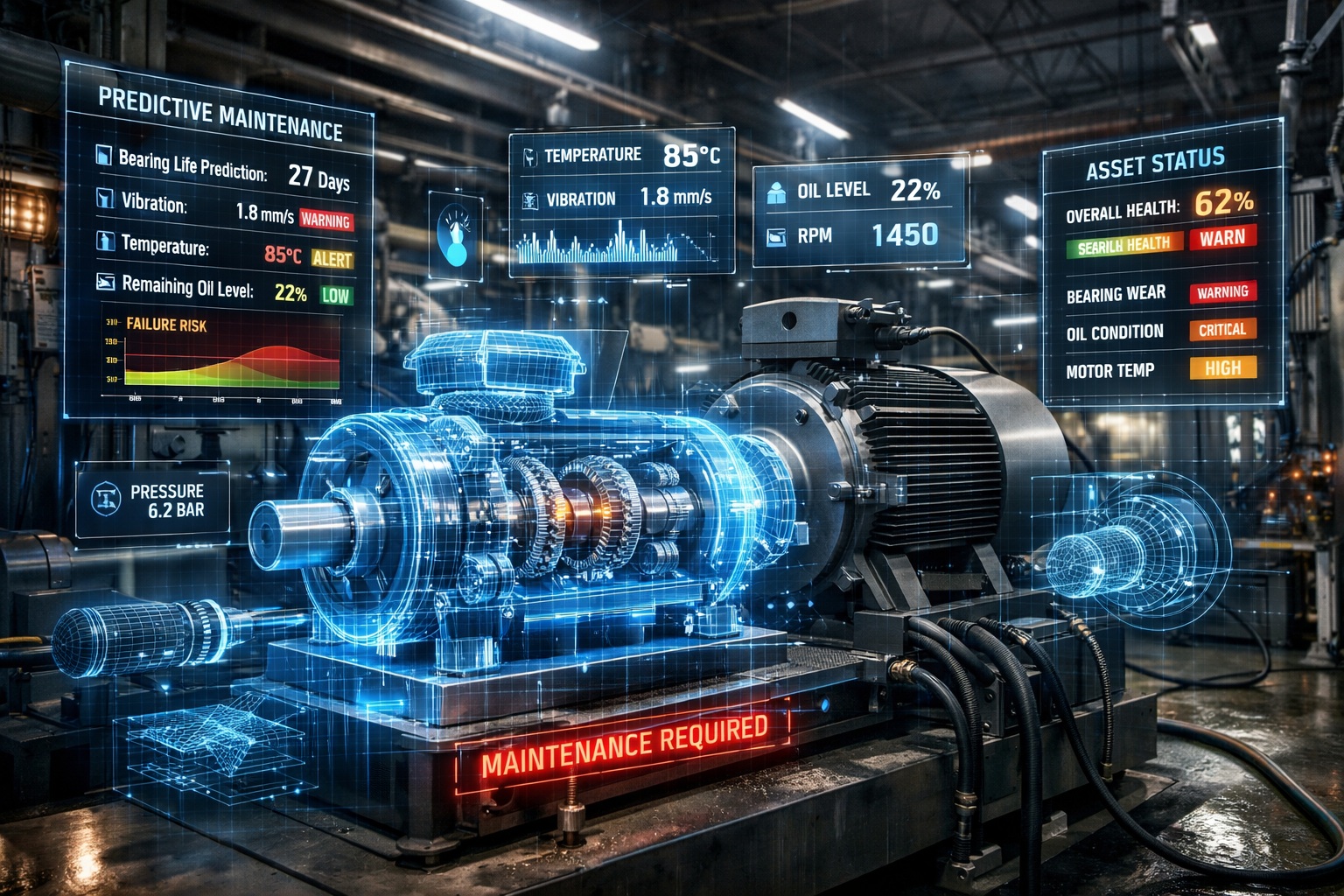
The operating models and AI examples in this article are illustrative. They are not a specification of included UpFix features or a measured customer result. See product capabilities and plan limits for the current offer.
For the past five years, the reliability and maintenance world has been rightly obsessed with predictive maintenance (PdM). The formula is powerful: gather massive amounts of sensor data, feed it into a machine learning algorithm, and get an early warning before a component fails. This approach is preventing countless failures. But as incidents like the recent Norfolk Southern derailments show, it has a critical blind spot. The wayside detectors did flag the overheating wheel bearing, but the alert came too late to prevent disaster.
This is the inherent limit of a purely data-driven, historical approach. It is excellent at identifying when a component is behaving outside of its known, normal parameters. It is less effective at understanding the complex, cascading consequences of that deviation in real-time. What happens when that bearing fails at 50 mph, on a specific curve, carrying a particular load? How will the resulting forces propagate through the train and the track?
Answering these questions requires more than just historical data; it requires a predictive model grounded in the laws of physics. It requires a Digital Twin. This isn't just a 3D model or a dashboard; it's a living, breathing, scientifically accurate simulation of a physical asset, and it represents the next leap forward in industrial maintenance and reliability.
The Anatomy of a Systemic Failure
Complex systems fail in complex ways. A single component failure is often just the trigger for a much larger cascade that is difficult, if not impossible, to predict using historical data alone, because the specific combination of circumstances may have never happened before.
What breaks in real-world failure analysis:
- Linear Extrapolation: Standard predictive models often assume a linear degradation path. They see a bearing getting hotter and predict a failure in X hours. But in reality, failure can be non-linear, with a sudden, catastrophic collapse once a certain threshold is crossed.
- Ignoring System Dynamics: A single component's health is analyzed in isolation. The model knows the bearing is failing, but it doesn't understand how that failure will dynamically affect the entire system, the truck, the car, the train, and the track—under a specific set of operational conditions.
- The "Black Box" Problem: Many machine learning models are "black boxes." They can tell you that something is likely to fail, but they can't always explain the underlying physical reason why. This makes it difficult to build true resilience into the system.
- Inability to Test Scenarios: You cannot safely test a real-world train to see what happens when a bearing fails at high speed. The risk is too great. This leaves a critical gap in understanding and preparing for the worst-case scenarios.
"What Good Looks Like": The Engineering-Grade Digital Twin
A Digital Twin bridges the gap between the data world and the physical world. It is a simulation model that is continuously updated with real-world sensor data, creating a virtual replica that behaves exactly like its physical counterpart.
- Physics-Based Simulation: The twin is built on engineering principles, finite element analysis, computational fluid dynamics, multibody dynamics. It understands stress, strain, heat transfer, and material fatigue.
- Real-Time Data Ingestion: Data from IoT sensors (thermal, vibration, etc.) is fed into the twin in real-time. This doesn't just train an algorithm; it updates the current state of the simulation. The twin knows the actual, current condition of every critical component.
- "What-If" Scenario Modeling: This is the game-changer. Once an anomaly is detected (e.g., a bearing is running 15% hotter than baseline), operators can run simulations. "What if we continue running for another 50 miles? What is the probability of a catastrophic failure given the current track geometry and train speed? What if we reduce speed to 30 mph?"
- Virtual Commissioning and Testing: Engineers can use the twin to test new maintenance strategies or component designs before deploying them in the real world. "Would a different bearing material have a longer lifespan under these load conditions? What is the optimal inspection interval to balance cost and risk?"
The AI Maintenance Angle: Fusing Data Science with Physical Science
In this new paradigm, AI and machine learning don't go away. Instead, they are fused with the digital twin to create a far more powerful solution.
- Where AI & Digital Twins Collaborate:
- Intelligent Anomaly Detection: AI still does the heavy lifting of sifting through sensor data to find the initial, subtle signs of a problem. It acts as the trigger for the digital twin.
- Simulation Acceleration: Machine learning can be used to create "surrogate models" that approximate the results of complex physics simulations, allowing for faster-than-real-time "what-if" analysis.
- Calibrating the Twin: AI algorithms can compare the twin's predictions with real-world outcomes, continuously refining and calibrating the simulation to make it more accurate over time.
- Prescriptive Action: The combined system doesn't just say "your bearing is failing." It says, "Your bearing is showing early signs of spalling. Our simulation shows a 75% chance of catastrophic failure within the next 100 miles at current speed. We recommend reducing speed to 25 mph and scheduling a replacement at the next service stop, 60 miles ahead."
- Why One Isn't Enough:
- A predictive model without a physics-based twin is a black box that is blind to novel conditions and systemic risk.
- A digital twin without AI and real-time data is just a static engineering model, a digital dinosaur that doesn't reflect the current reality of the asset.
Practical Playbook: 7 Actions for Leaders in the Next 30 Days
- Identify Your Most Complex System: Choose one asset or process where failures are driven by complex, interacting forces, not just simple component wear.
- Inventory Your Engineering Models: Your organization likely already has CAD, FEA, or other engineering models. Find them. They are the starting point for a digital twin.
- Start with a "Digital Thread": Focus on creating a seamless flow of data from the physical asset to its virtual counterpart, even if the model is simple at first.
- Ask "What-If" Questions: Get your engineering and operations teams together. What are the high-consequence scenarios they wish they could test but can't? This is your use-case list for a digital twin.
- Think "Twin of a System," Not "Twin of a Part": The real value comes from simulating the interactions between components, not just a single part in isolation.
- Find a Simulation Partner: Building high-fidelity digital twins is a specialized skill. Look for partners who have experience in your specific industry and asset types.
- Reframe the Business Case: A digital twin isn't a maintenance expense; it's an investment in operational resilience and risk mitigation. Frame it in terms of preventing your company's "East Palestine" moment.
Conclusion: From Reactive to Resilient
The future of maintenance is not just about reacting faster or predicting failures a few hours earlier. It's about creating truly resilient systems that can anticipate, understand, and mitigate risk in a dynamic world. Data-driven prediction was the first step. The fusion of AI and physics-based Digital Twins is the next. It allows us to move from being observers of our assets to being the architects of their reliability, capable of testing the future before it arrives and ensuring that the next "one-percent" failure never becomes a front-page disaster.
Key Takeaways
- Predictive maintenance based on historical data has limits, especially in preventing complex, cascading failures.
- Digital Twins combine real-time sensor data with physics-based simulations to create a living, scientifically accurate model of an asset.
- The key capability of a Digital Twin is running "what-if" scenarios to understand the consequences of a failure before it happens.
- The most powerful approach fuses AI for anomaly detection with Digital Twins for risk simulation and prescriptive guidance.
- Investing in Digital Twins is a strategic move towards building truly resilient operations, not just a tactical maintenance upgrade.
Signals to Watch (Next 6 Months)
- "Digital Twin" in Financial Reports: Leading industrial companies will start citing their Digital Twin initiatives in annual reports as proof of their risk management and resilience strategies.
- Simulation-as-a-Service (SaaS): Expect the rise of cloud-based platforms that make it easier and cheaper for companies to build and deploy Digital Twins without massive upfront investment.
- The "Chief Reliability Officer": A new executive role may emerge, responsible for a holistic view of operational risk that spans maintenance, engineering, and data science.
- Standardization Efforts: Industry consortiums will begin to work on standards for Digital Twin data formats and interoperability.
- Regulatory Requirements for Simulation: For critical infrastructure (like rail, grid, aviation), regulators may eventually require companies to use certified Digital Twins to prove the safety and resilience of their systems.
UpFix is an operations and work management platform with CMMS capabilities. Keep requests, Work Items, procedures, and service history together. Recurring automations require Team or Pro; inventory, analytics, purchasing, and the built-in Assistant require Pro. Connected meter data depends on supported integrations and configuration.