
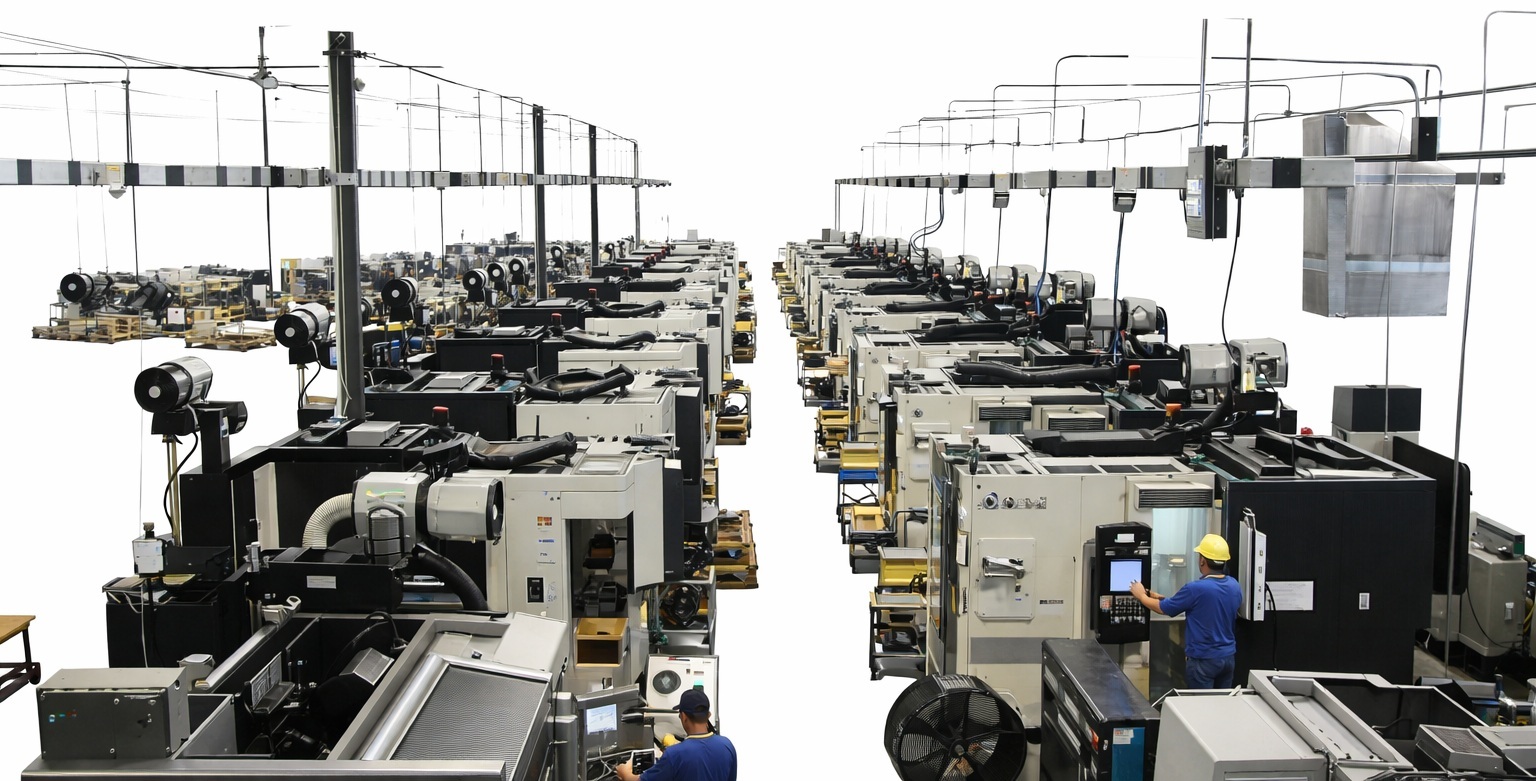
Manufacturing Maintenance Use Cases

One clear workflow for the work that keeps production moving

UpFix helps manufacturing teams coordinate maintenance requests and project work, reduce unplanned downtime, standardize preventive maintenance across shifts, and capture maintenance knowledge so every work item makes the plant smarter.

PM schedules by date, runtime, meter, or cycles
Shift-consistent checklists and procedures
Manuals, SOPs, and troubleshooting notes in one place
Work item data turned into reliability insight
Production line equipment maintenance use case
Primary goal Reduce unplanned downtime
Best for Plant equipment + production lines
High-value workflow Breakdown + PM tracking
Preventive maintenance for critical assets Schedule PM tasks by date, runtime, meter readings, or cycle count to reduce unexpected stoppages.
Work items tied to real equipment history Track every repair, replacement, and technician note on the asset that caused the downtime.
Manuals and repair instructions in one place Store OEM manuals, SOPs, lockout steps, and troubleshooting procedures for every machine.
Downtime and repeat failure visibility See which assets cause the most disruption and where repeat problems keep returning.

Production line equipment maintenance

Keep production moving by managing maintenance for conveyors, motors, pumps, presses, packaging equipment, CNC machines, and other critical plant assets in one system built for uptime and fast response.

  • Track planned and unplanned maintenance across production equipment and plant assets
  • Centralize equipment manuals, maintenance procedures, and service history
  • Create work items quickly for line stoppages, breakdowns, and scheduled PM tasks
  • Reduce response time by making past fixes and repair notes easy to find
  • Use maintenance history to identify chronic equipment failures and reliability trends
  • Support better repair-versus-replace decisions with full asset maintenance records
Ideal for: production plants, packaging lines, machining operations, food processing, and mixed manufacturing environments.

Preventive maintenance across shifts use case
Primary goal Standardize PM across shifts
Best for Multi-shift maintenance teams
High-value workflow Shift-consistent inspections
PM schedules teams can actually follow Automate recurring maintenance schedules so routine PM is not missed during busy production periods.
Checklists that create consistency Use daily, weekly, monthly, and shutdown checklists to enforce standard work across every shift.
Task instructions attached to the work Give every technician the same procedures, parts, safety notes, and completion requirements.
Track completion and missed PM risk See what was completed, what slipped, and where compliance is breaking down before it causes downtime.

Preventive maintenance across shifts

Standardize PM across technicians, shifts, and facilities so maintenance tasks are completed the same way every time, with clear instructions, inspections, and accountability.

  • Schedule preventive maintenance by calendar, runtime, meter, cycle count, or production thresholds
  • Standardize PM tasks across shifts, technicians, and multiple plants or production areas
  • Attach checklists, procedures, parts lists, and safety steps directly to maintenance work orders
  • Use inspection workflows to surface issues early and trigger follow-up maintenance automatically
  • Reduce PM drift caused by handoffs, turnover, and inconsistent technician practices
  • Create accountability for completion, review, and follow-up on recurring PM tasks
Ideal for: plants with multiple shifts, high PM volume, cross-functional maintenance teams, and facilities scaling standard work.
Maintenance knowledge capture and repeat failure reduction use case
Primary goal Retain knowledge + reduce repeat failures
Best for High-turnover or knowledge-heavy teams
High-value workflow Searchable repair history
Store the fix, not just the work item Document what failed, what fixed it, what parts were used, and what to check next time.
Make troubleshooting searchable Let technicians quickly find past fixes, notes, manuals, and SOPs tied to similar failures.
Identify recurring failures sooner Use work item history to spot assets, lines, or failure types that repeatedly cause disruption.
Help new techs ramp faster Reduce dependency on senior technicians by making proven maintenance knowledge easy to access.

Maintenance knowledge capture and repeat failure reduction

Capture tribal maintenance knowledge before it walks out the door and turn work item history into reliability intelligence that helps teams troubleshoot faster and stop solving the same equipment issues from scratch.

  • Capture troubleshooting notes, repair steps, and root-cause context inside the maintenance workflow
  • Store SOPs, manuals, diagrams, and recurring repair procedures in one searchable system
  • Track repeated failures across assets, equipment types, and production areas
  • Turn work item history into actionable reliability insight instead of static records
  • Reduce dependency on tribal knowledge and improve cross-shift handoffs
  • Improve troubleshooting speed and consistency for newer maintenance technicians
Ideal for: plants managing experienced technician turnover, chronic equipment issues, and reliability improvement initiatives.

See UpFix in your plant

Reduce unplanned downtime, standardize PM across shifts, and make every work item more valuable with one maintenance platform built for real manufacturing teams.

Track PM, inspections, manuals, and work items in one place Standardize maintenance procedures across shifts and technicians Use maintenance history to find recurring failures faster Protect institutional knowledge before it disappears
Start with your highest-value workflow

Most manufacturing teams begin with PM scheduling, work item tracking, and maintenance knowledge capture, then expand into analytics, inspections, and reliability improvement.

Free includes Work Items (including maintenance work orders) and basic procedures within its capacity limits. Recurring maintenance automations require Team or Pro. Inventory, purchasing, analytics, the UpFix Assistant, and multiple sites require Pro. Compare capabilities and limits.