Refinery Turnarounds Under Supply Shock Need an AI Maintenance Nerve Center
By UpFix
How plants should re-sequence maintenance when feedstock shocks force unplanned unit downtime.

The operating models and AI examples in this article are illustrative. They are not a specification of included UpFix features or a measured customer result. See product capabilities and plan limits for the current offer.
When crude and feedstock flows change overnight, plants do not get to pause and think. They have to decide, fast, whether to run unstable, slow down, or pull work forward. In March, Reuters reported that some Asian refiners cut runs and brought maintenance forward as Middle East disruption hit supply planning. That is not a routine scheduling tweak. It is a reliability event.
The old model says: annual plan, fixed turnaround window, controlled scope. The new reality is more volatile. Maintenance leaders now need a dynamic operating model that can absorb market shocks without turning every disruption into an unsafe scramble.
Why this is now a maintenance problem, not just a market problem
Supply-side volatility exposes a weakness most sites already have: planning systems that assume stable operating conditions. When that assumption breaks, backlog quality, parts readiness, and contractor sequencing all crack at the same time.
Three things usually fail first:
- Scope discipline: teams add work ad hoc when units come down unexpectedly.
- Resource realism: planners underestimate specialist constraints and permit bottlenecks.
- Learning speed: events are logged, but not converted into repeatable decision rules.
Root cause analysis: why emergency resequencing goes wrong
1) The work list is not reliability-ranked
Many backlogs are age-ranked, not consequence-ranked. During a shock, teams grab visible overdue work rather than high-risk failure modes.
2) Materials status is disconnected from job criticality
Critical-path tasks frequently share the same procurement treatment as low-impact tasks. In a compressed window, this creates avoidable idle time and unsafe rushing.
3) Shift-level decisions are not fed back into planning logic
Operators and supervisors adjust every day, but those adjustments often stay in chat threads and notebooks. The plan never gets smarter.
What good looks like in 2026
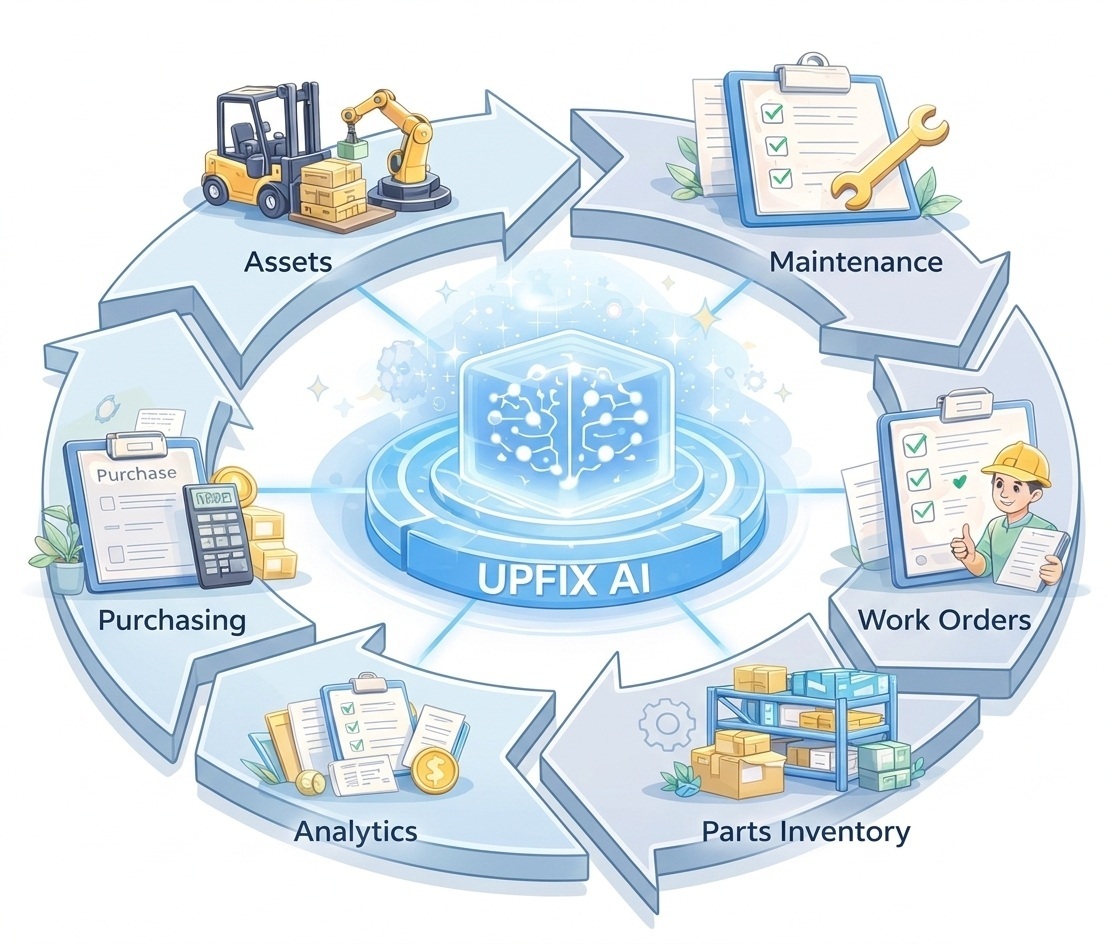
High-performing plants treat unplanned shutdown opportunities as controlled micro-turnarounds. They do not improvise from scratch. They run a playbook with an AI maintenance intelligence layer connecting telemetry, work orders, permit workflow, and historical failure knowledge.
AI should not replace planners. It should compress the time from signal to executable maintenance decision. If this resonates, checkout UpFix.
AI-native execution model for supply-shock turnarounds
Decision layer
- Rank candidate jobs by safety and production consequence, not due date alone.
- Model completion probability for each job inside the available downtime window.
- Flag tasks likely to create restart risk if partially completed.
Execution layer
- Auto-generate daily resequencing recommendations from real progress and permit constraints.
- Push role-specific instructions to planners, supervisors, and stores.
- Continuously reconcile planned versus actual wrench time to protect restart readiness.
9-step playbook for maintenance leaders
- Step 1: Trigger a reliability command window. Open a 72-hour control cadence with operations, maintenance, stores, and safety in one room.
- Step 2: Freeze and classify scope. Split work into must-do, should-do, and defer groups using consequence criteria.
- Step 3: Rebuild critical path. Recompute dependencies based on real labor and permit limits, not baseline assumptions.
- Step 4: Lock materials for must-do work. Escalate procurement and kitting for top-risk tasks only.
- Step 5: Assign restart gatekeepers. Name owners for rotating equipment, instrumentation, and power quality sign-off.
- Step 6: Use AI for variance detection. Flag when completion confidence drops below threshold and force replan.
- Step 7: Protect craft productivity. Remove non-critical interruptions and reduce permit queue friction.
- Step 8: Run end-of-shift learning capture. Record blocked causes and recovery actions in structured form.
- Step 9: Publish post-event decision rules. Convert lessons into trigger logic for the next disruption.
Signals to Watch
- Rising ratio of emergency work orders to planned work during volatility periods.
- Critical-path jobs with incomplete kits inside T-24 hours.
- Permit backlog growth outpacing crew completion rate.
- Restart delays caused by instrumentation or electrical closeout gaps.
- Repeated scope churn after shift handover.
Bottom line for executives
Supply shocks are no longer rare exceptions. They are a recurring operating condition. Plants that keep treating maintenance planning as static will lose availability and increase risk. Plants that run an AI-native maintenance intelligence loop can absorb turbulence and restart with control.
That is the strategic move: connect telemetry, work orders, and operating knowledge so each disruption makes the next response faster and safer.