
Manufacturing Needs an AI Maintenance Control Tower
By UpFix
A contrarian blueprint for factories to move beyond OEE fixation and build closed-loop maintenance intelligence under labor pressure.
The operating models and AI examples in this article are illustrative. They are not a specification of included UpFix features or a measured customer result. See product capabilities and plan limits for the current offer.
Stop worshipping OEE: your next bottleneck is maintenance cognition
Manufacturers still spend too much time debating OEE decimals while losing real money in diagnostic delays, repeat failures, and handoff friction between production and maintenance. In a market where labor pressure and asset complexity are rising together, the limiting factor is no longer just wrench time, it is decision quality under time pressure.
This is the contrarian reality for 2026: factories do not need more alerts. They need better maintenance cognition at scale.
Why now: the labor and complexity collision
Industry outlooks continue to flag persistent workforce pressure in manufacturing, including shortages in technical roles. At the same time, plants are adding automation, edge sensors, and software-defined controls that increase data volume and interdependency. The result is a dangerous asymmetry: more signals, fewer deeply experienced people to interpret them consistently.
When plants respond by adding standalone tools, they often intensify fragmentation. Teams can see more and understand less. That is how organizations end up with full dashboards and empty confidence.
Root cause analysis: why predictive maintenance pilots stall
Pilot logic never reaches frontline workflow
Models may detect anomalies, but alerts are not translated into executable work packages with parts, skills, and lockout implications.
Weak knowledge capture
Post-failure learning is recorded inconsistently, making recurrence reduction slow and site dependent.
No closed-loop governance
Teams track model precision, but not business outcomes such as avoided downtime, faster stabilization, or reduction in repeat work.
Planner-technician disconnect
Planning systems optimize schedule efficiency while technicians face real-world ambiguity not represented in the work order.
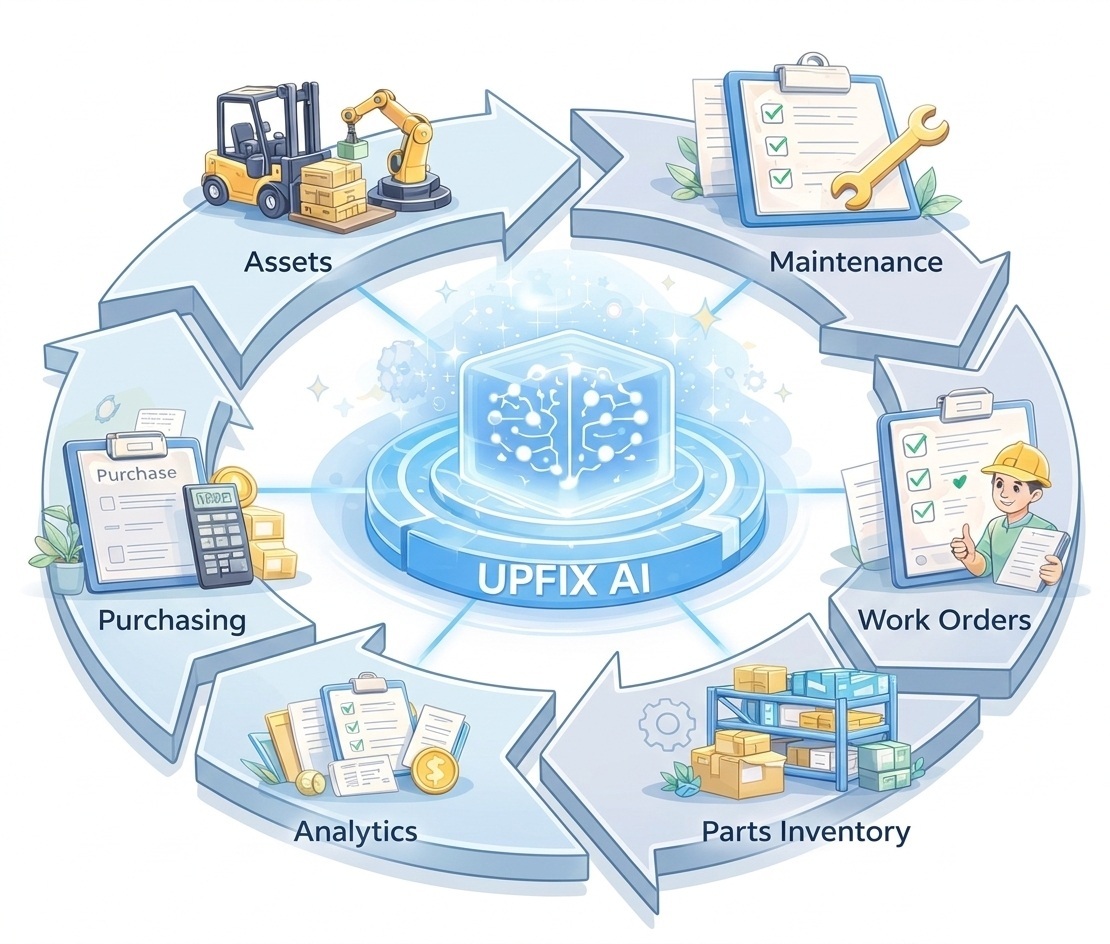
What good looks like: an AI maintenance control tower
UpFix is an operations and work management platform with CMMS capabilities. Keep requests, Work Items, procedures, and service history together. Recurring automations require Team or Pro; inventory, analytics, purchasing, and the built-in Assistant require Pro. Connected meter data depends on supported integrations and configuration.
In this model, the value is not “prediction” alone. The value is orchestration, getting the right action done by the right team at the right time with the fewest repeat failures.
Implementation playbook: 10 moves that separate leaders from pilots
- Start with failure economics: Rank assets by consequence of failure, not by sensor richness.
- Define an actionable anomaly standard: Every alert must map to a known decision path and owner.
- Unify historian and CMMS semantics: Align asset naming, event taxonomy, and work-order coding to enable retrieval and learning.
- Build repairability into alert design: Include probable cause, required inspection, likely parts, and safety prerequisites.
- Introduce AI-assisted planning: Auto-suggest bundled maintenance windows that minimize production disruption.
- Turn technician feedback into model features: Capture what was found, what was replaced, and what actually solved the issue.
- Create recurrence heatmaps: Track repeat failures by line, shift, and intervention type to target process fixes.
- Build capability ladders: Pair digital tools with structured upskilling for planners and technicians.
- Govern by outcome KPIs: Measure avoided downtime, mean-time-to-stability, and repeat-work reduction.
- Institutionalize monthly reliability retrospectives: Convert lessons into SOP updates and model tuning priorities.
Signals to Watch
- High volume of alerts closed with no maintenance action
- Rising emergency work ratio despite predictive tools in place
- Repeat failures on the same assets within one production quarter
- Planner schedule adherence improving while downtime volatility worsens
- Growing gap between anomaly detection count and verifiable avoided losses
Executive takeaway
The next frontier in manufacturing maintenance is not another dashboard and not another isolated model. It is operating discipline powered by connected intelligence. Plants that build this loop will outperform on uptime, safety, and labor productivity even in constrained talent markets. Plants that do not will keep mistaking activity for progress.
Maintenance has entered the cognition era. The control tower is no longer optional.