
How Airbnb Property Managers Can Keep Up With Multiple Properties, Assets, and Maintenance Requests
By UpFix
Managing Airbnb maintenance across properties gets messy fast. Here is a practical system for HVAC, appliances, inventory, contractor assignment, and unified work requests.
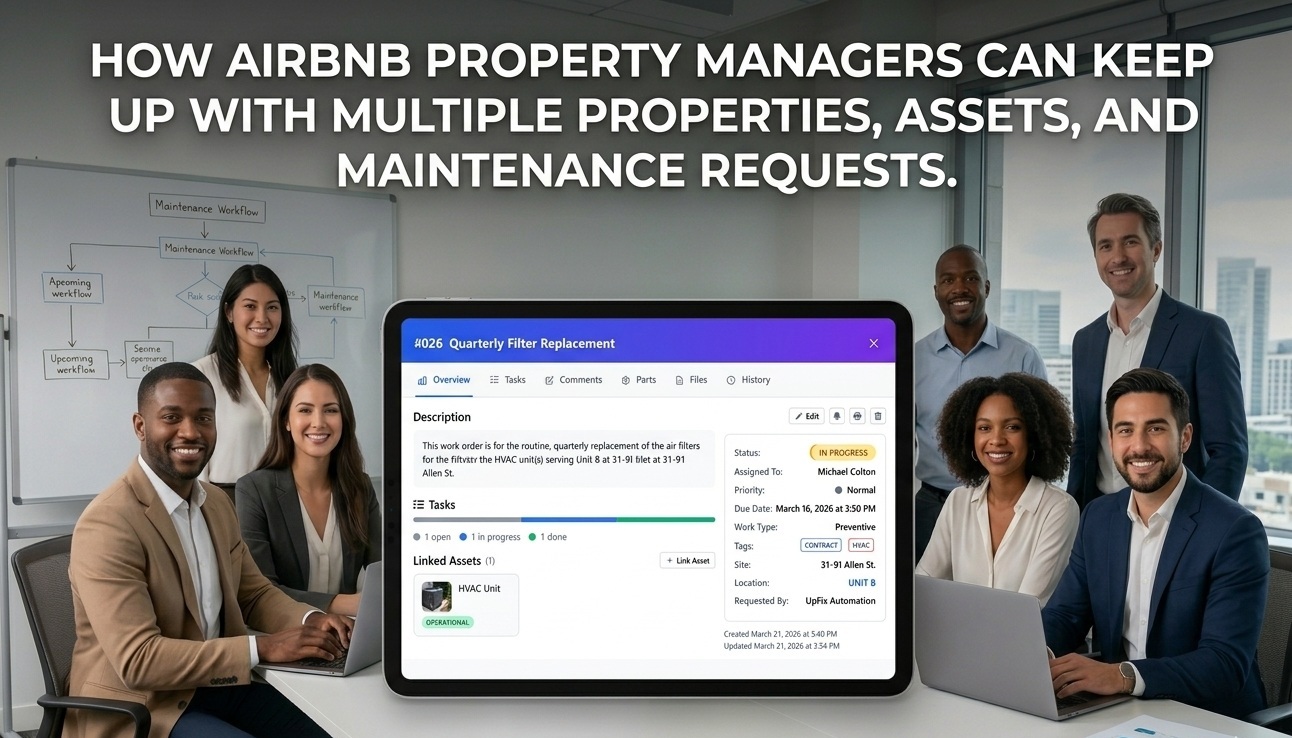
The operating models and AI examples in this article are illustrative. They are not a specification of included UpFix features or a measured customer result. See product capabilities and plan limits for the current offer.
Managing one Airbnb is operations. Managing ten is a system problem.
Most property managers start with what works: spreadsheets, group chats, and a few trusted contractors on speed dial. At one or two properties, that can hold.
At five, ten, or twenty units, it breaks. Not because your team is weak. Because your maintenance process has no single source of truth.
If you manage short-term rentals, the pain is predictable. HVAC checks are missed before heat waves. Appliance failures get fixed but not logged. Inventory gets restocked at one property and forgotten at another. Guests report issues in multiple channels, and work gets duplicated or dropped.
This is exactly where a unified platform like UpFix Product becomes less of a nice-to-have and more of an operating requirement.
The most common property manager pain points in multi-property Airbnb operations
1) Maintenance requests are fragmented
Requests come from guest messages, cleaner notes, owner calls, and contractor texts. Without one intake path, response times vary and accountability disappears.
2) Asset visibility is weak
Teams know the unit address, but not full asset context. Which mini-split is in Unit B? What was repaired last quarter? Which dishwasher has repeated drain issues?
3) Preventive maintenance is reactive in disguise
Most teams think they are doing PM. In reality, PM tasks happen when someone remembers. That means seasonal failures are still driving emergency work.
4) Contractor assignment is manual and inconsistent
Every dispatch is a custom decision. Who is available? Who has access? Who worked this property before? Manual routing slows response and increases mistakes.
5) Inventory is tracked loosely
Critical spares and consumables are often counted by feel, not by system. Teams run out of water filters, lock batteries, thermostat covers, or appliance parts at the worst time.
6) No reliable performance view
Without centralized data, you cannot answer simple questions quickly. Which properties generate the most maintenance cost? Which contractors close work fastest? Which assets are recurring problems?
What an effective multi-property maintenance workflow looks like
You do not need more complexity. You need one system connecting requests, assets, tasks, parts, and people.
Unified maintenance request intake
Every issue should enter one queue, regardless of source. Then it can be prioritized, assigned, and tracked from open to close.
UpFix supports this through structured work management in the main product workspace, so teams stop losing requests in chat threads and inboxes.
Asset-level system of record
Each HVAC unit, appliance, smart lock, and key piece of equipment should have a persistent record with location, service history, documents, and status.
That gives you a real equipment maintenance timeline, not scattered notes across tools.
Preventive maintenance scheduling by season and usage
Airbnb operations need calendar-based and condition-aware routines. HVAC pre-season checks, smoke detector tests, appliance inspections, and water system checks should be automated, not memory-based.
Start on the Free plan with work requests and asset records. Recurring date- or meter-based maintenance automations require Team or Pro, including any eligible paid-plan trial.
Smart work assignment and contractor distribution
A scalable workflow routes jobs by trade, location, urgency, and availability. Assign once, track status, and escalate only when needed.
This reduces phone-tag dispatching and gives managers visibility into who owns each task right now.
Inventory tied to maintenance work
Parts usage should connect directly to work orders. When a contractor replaces a component, inventory updates should reflect that action immediately.
This closes the loop between procurement and field execution.
Illustrative workflow: a 14-property operator
Consider a team moving from spreadsheets and messages into a shared work queue. Map records to their property or site, assign an owner to each request, and record the outcome. On Team or Pro, add recurring maintenance automations; on Pro, connect parts usage and multi-site reporting. These are suggested steps, not reported customer results.
How to implement this without overhauling everything at once
Step 1: Standardize your property and asset structure
Define naming conventions for properties, units, and equipment classes. Clean structure first prevents data chaos later.
Step 2: Move all new requests into one workflow
Do not migrate everything on day one. Start by ensuring all incoming issues are created and tracked in one place.
Step 3: Add high-risk PM automations first
Prioritize HVAC, safety checks, leak-prone systems, and high-failure appliances.
Step 4: Define contractor assignment rules
Route by trade and geography, set response SLAs, and enforce closeout fields to preserve history.
Step 5: Connect parts and consumables to work orders
Track real usage and set minimum stock thresholds for critical items.
Step 6: Review weekly with three operational metrics
- Open vs overdue work orders
- Repeat issues by asset and property
- Mean time to complete by contractor type
This is enough to drive meaningful control without creating enterprise-level overhead.
Where UpFix fits for Airbnb and property teams
UpFix gives property managers a practical bridge between spreadsheet operations and full-scale maintenance intelligence.
- Product platform for assets, work orders, procedures, and team visibility
- Free CMMS entry point for teams that need to start now without procurement friction
- Direct signup for quick rollout and pilot deployment
You can start lightweight, then scale workflows as property count and contractor volume increase.
Bottom line
Airbnb maintenance gets hard when growth outpaces coordination. The fix is not more spreadsheets. It is a connected workflow where requests, assets, inventory, and assignments live in one system.
If your team is already juggling multiple properties and recurring equipment issues, this is the point to centralize.
Start with Free CMMS, explore the full UpFix product, and launch your workspace from signup.